Empowering your business with innovative IT solutions that drive growth.
 Support : +1 (516) 851-8918


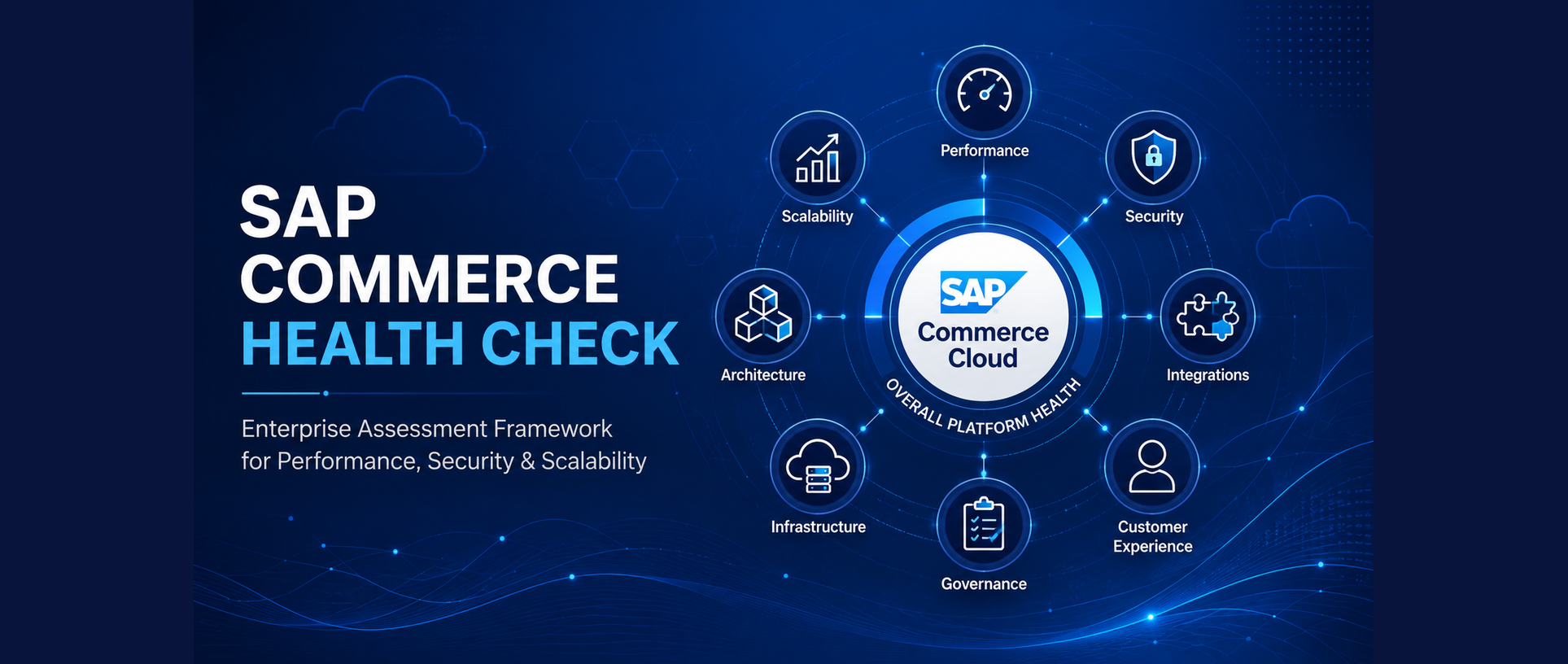
SAP Commerce Health Check: A Complete Guide to Improving Performance, Security & Customer Experience
SAP Commerce Cloud supports essential digital commerce for many businesses. However, as business requirements change, the performance, security, integrations, and scalability of the platform can decline over time.
An SAP Commerce Health Check is a structured assessment that reviews the overall condition of your SAP Commerce environment. It helps identify performance issues, security threats, technical debt, and chances for improvement.
This guide presents the SAP Commerce Health Assessment Framework. It uses an eight-pillar approach to evaluate business alignment, infrastructure, architecture, security, integrations, customer experience, and operational readiness. Whether you are getting ready for an upgrade, expanding your commerce platform, or enhancing customer experience, this framework offers a practical plan for creating a secure, high-performing, and future-ready SAP Commerce environment.
What is an SAP Commerce Health Check?
An SAP Commerce Health Check is a comprehensive assessment of an organization's SAP Commerce Cloud environment. It evaluates platform performance, infrastructure, security, integrations, customizations, customer experience, scalability, and operational readiness to identify risks, improve performance, and support long-term business growth.
Introduction:
Enterprise digital commerce has come a long way from just managing an online store. Today’s customers expect fast, secure, and personalized experiences at every digital touchpoint. To meet these expectations, businesses need to do more than just implement SAP Commerce Cloud. They must also monitor, optimize, and manage their strategies continuously.
As SAP Commerce environments expand, new integrations, customizations, and business needs add to the platform's complexity. Without regular assessments, organizations may face performance issues, security threats, technical debt, and decreased operational efficiency.
An SAP Commerce Health Check offers a clear method for evaluating how well your commerce platform is performing. Unlike a standard technical audit, it looks at both technical performance and business readiness. This helps organizations answer important questions like:
- Is the platform running efficiently and ready to grow?
- Are security measures and integrations working as they should?
- Is custom code making maintenance and future upgrades difficult?
- Where should optimization efforts be focused?
By spotting issues before they affect customers or operations, a structured health assessment allows business leaders to make informed choices about modernization, upgrades, and long-term digital commerce plans.
Why Every Enterprise Needs an SAP Commerce Health Check
Organizations that regularly assess their SAP Commerce environment are better positioned to improve customer experience, reduce operational risk, support business growth, and maximize technology investments. A proactive health assessment helps identify issues early—before they become costly business challenges.
Business Drivers:
| Business Driver | Business Value |
|---|---|
| Improve Customer Experience | Faster performance, better search, and friction-free checkout increase customer satisfaction and conversions. |
| Support Business Growth | Ensure the platform scales efficiently for new markets, products, and seasonal demand. |
| Prepare for Platform Upgrades | Identify technical debt, customizations, and integration risks before upgrading. |
| Reduce Operational Risk | Detect security, infrastructure, and performance issues before they impact the business. |
| Maximize Technology Investments | Optimize existing SAP Commerce capabilities to improve ROI and long-term value. |
Introducing the SAP Commerce Health Assessment Framework
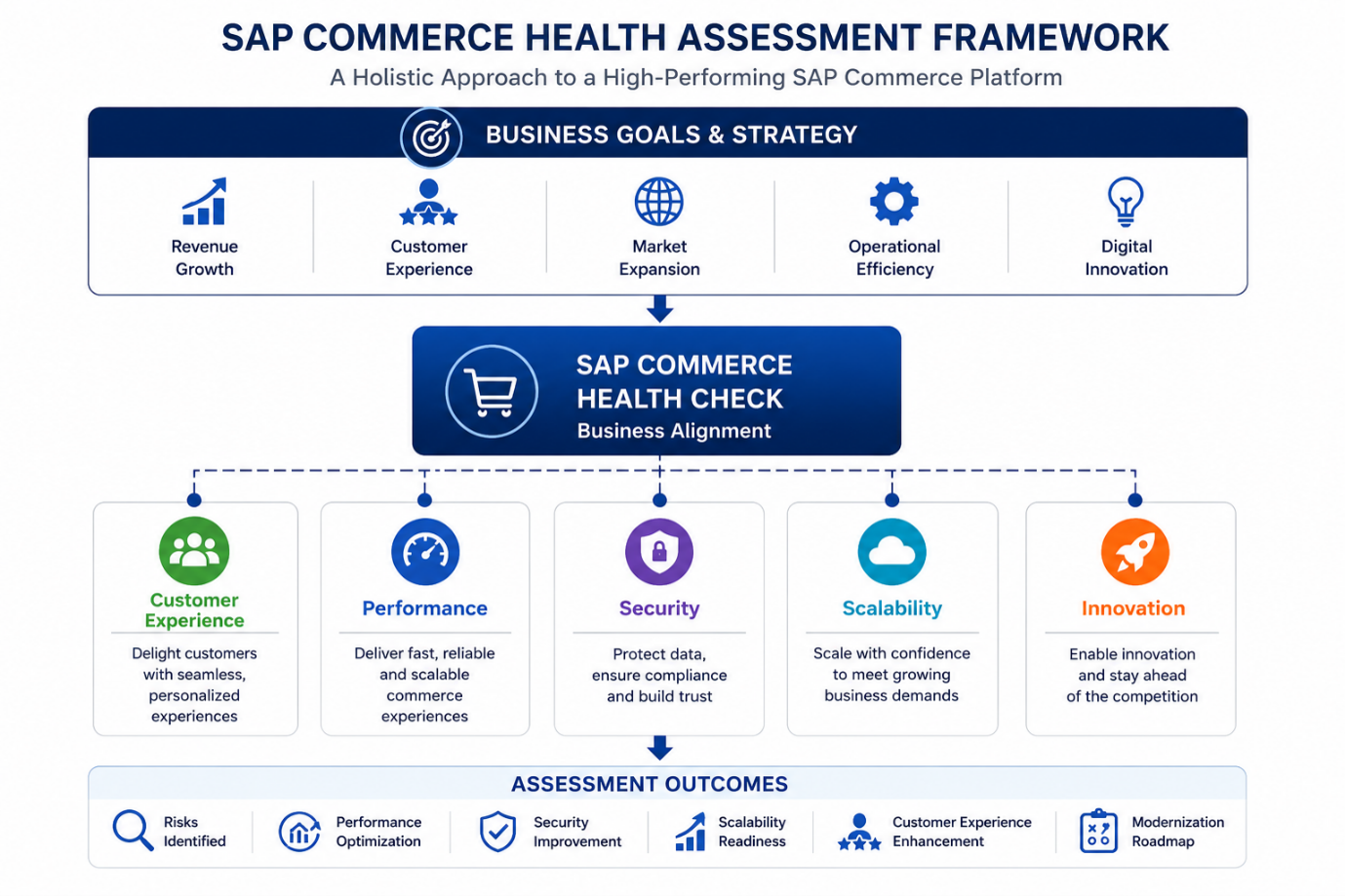
A comprehensive SAP Commerce Health Check should evaluate more than infrastructure or application performance. While these technical components are essential, they represent only part of an enterprise commerce platform's overall health.
An effective assessment should examine multiple dimensions that influence business performance, customer experience, security, scalability, and long-term maintainability.
The SAP Commerce Health Assessment Framework presented in this guide organizes the assessment into eight critical dimensions, providing a structured approach for evaluating the current state of an SAP Commerce environment and identifying opportunities for continuous improvement.
Rather than asking only:
"Is the platform running?"
A comprehensive assessment asks:
"Is the platform enabling sustainable business growth, operational resilience, and exceptional customer experiences?"
The Eight Assessment Dimensions
- Business Alignment
- Infrastructure & Scalability
- Platform Performance
- Security & Compliance
- Architecture & Technical Debt
- Integrations & Data Flow
- Customer Experience
- Operational Excellence & Governance
Together, these assessment dimensions provide a balanced view of both business and technical readiness, helping organizations prioritize improvements that deliver measurable business value.
Assessment Dimension 1
Business Alignment - Strategy Before Technology
An SAP Commerce platform should support measurable business objectives rather than simply delivering technical functionality. A Business Alignment assessment evaluates whether the platform enables revenue growth, customer experience improvements, operational efficiency, market expansion, and future innovation.
By aligning technology investments with strategic business priorities, organizations can make informed decisions, reduce implementation risks, and maximize the long-term value of their SAP Commerce platform.
| Business Objective | Assessment Focus | Expected Outcome |
|---|---|---|
| Revenue Growth | Platform scalability | Increased sales capacity |
| Customer Experience | User journey & personalization | Higher customer satisfaction |
| Market Expansion | Multi-region readiness | Faster market entry |
| Operational Efficiency | Business process alignment | Lower operational costs |
| Digital Innovation | AI & future readiness | Continuous innovation |
Deliverables:
- Business Alignment Report
- Stakeholder Assessment
- Capability Gap Analysis
- Strategic Roadmap
Assessment Dimension 2
Infrastructure & Scalability
An enterprise commerce platform must remain available during traffic spikes, product launches, promotional campaigns, and seasonal demand. An infrastructure assessment evaluates whether the platform can scale efficiently while maintaining performance, availability, and resilience.
Key evaluation areas include:
- Cloud infrastructure
- Compute resources
- Storage utilization
- Network performance
- Auto-scaling configuration
- Disaster recovery
- Backup strategy
- High availability architecture
- Capacity planning
A resilient infrastructure supports current workloads while enabling future growth without significant architectural changes.
Assessment Dimension 3
Platform Performance
Customer expectations for speed continue to rise. Even a one-second delay in page load time can reduce engagement, conversion rates, and customer satisfaction. A performance assessment evaluates every layer of the SAP Commerce platform to identify optimization opportunities.
Key evaluation areas include:
- Page load performance
- Search response times
- Product catalog performance
- Checkout speed
- Database performance
- API response times
- Cache utilization
- Core Web Vitals
- Application monitoring
The objective is not only to measure speed but also to identify the root causes of performance issues and their business impact.
Assessment Dimension 4
Security & Compliance
Protecting Enterprise Commerce Beyond Traditional Security
SAP Commerce platforms process sensitive customer data, payment information, product catalogs, and business transactions. A comprehensive security assessment goes beyond vulnerability scanning—it evaluates identity management, application security, infrastructure, data protection, and regulatory compliance to reduce business risk and strengthen customer trust.
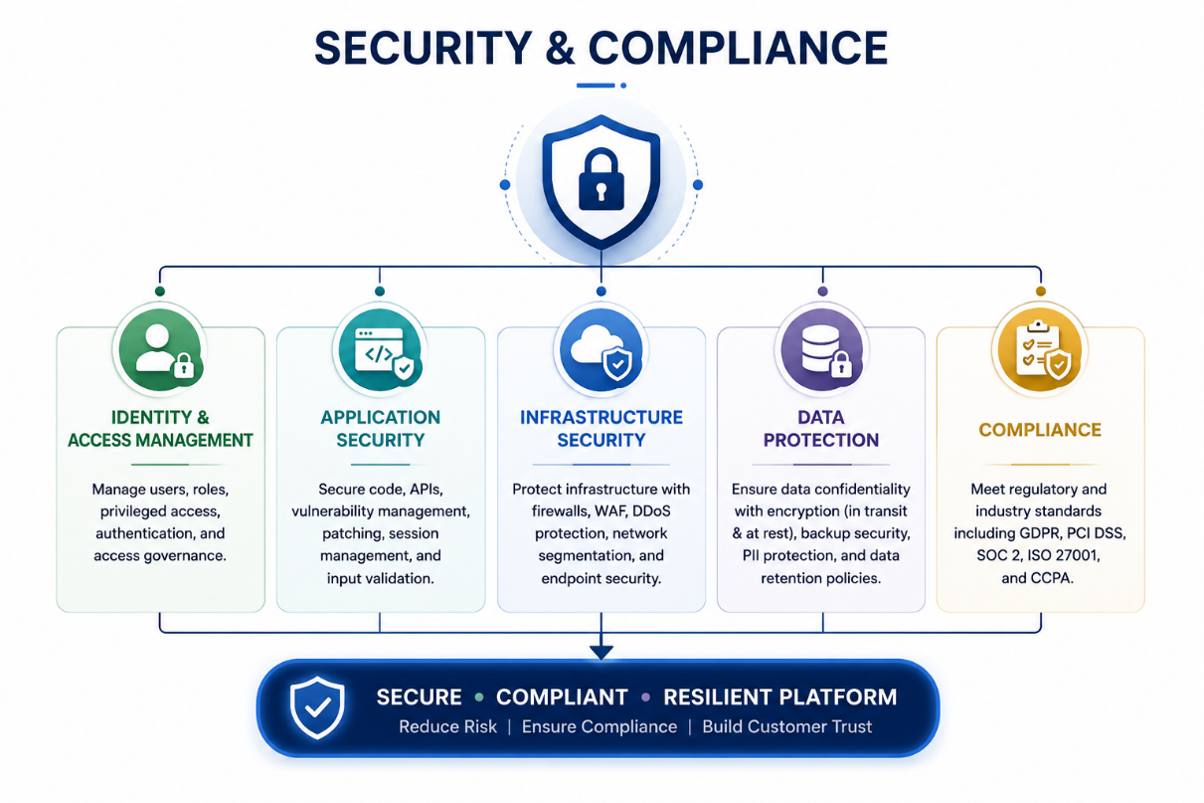
Modern SAP Commerce environments connect with ERP systems, payment gateways, CRM platforms, and third-party applications, making security a continuous business priority rather than a one-time audit. A comprehensive assessment evaluates five critical security domains to identify vulnerabilities, strengthen compliance, and improve operational resilience.
Assessment Areas
| Assessment Area | Evaluation Focus |
|---|---|
| Identity & Access Management | Roles, privileged access, MFA, password policies |
| Application Security | Vulnerability management, secure coding, API security |
| Infrastructure Security | Firewalls, WAF, DDoS protection, network security |
| Data Protection | Encryption, PII, backup security, data retention |
| Compliance | GDPR, PCI DSS, SOC 2, ISO 27001, CCPA |
Key Assessment Questions
- Are administrative privileges appropriately controlled?
- Is MFA implemented for privileged users?
- Are APIs protected using modern authentication?
- Are customer data and backups encrypted?
- Does the platform meet regulatory requirements?
Deliverables
| Deliverable | Business Value |
|---|---|
| Security Risk Report | Prioritized security risks |
| Vulnerability Assessment | Technical findings and remediation |
| Compliance Gap Analysis | Regulatory readiness |
| Identity & Access Review | Access governance improvements |
| Security Improvement Roadmap | Phased remediation plan |
Assessment Dimension 5
Architecture & Technical Debt
Build a Scalable and Future-Ready SAP Commerce Platform
SAP Commerce platforms naturally evolve as organizations expand, introduce new integrations, customize functionality, and support changing business requirements. While these changes enable growth, they can also introduce technical debt that increases maintenance costs, slows upgrades, and reduces platform agility.
An Architecture & Technical Debt assessment identifies structural issues that limit scalability and innovation, helping organizations simplify their environment and prepare for future modernization.
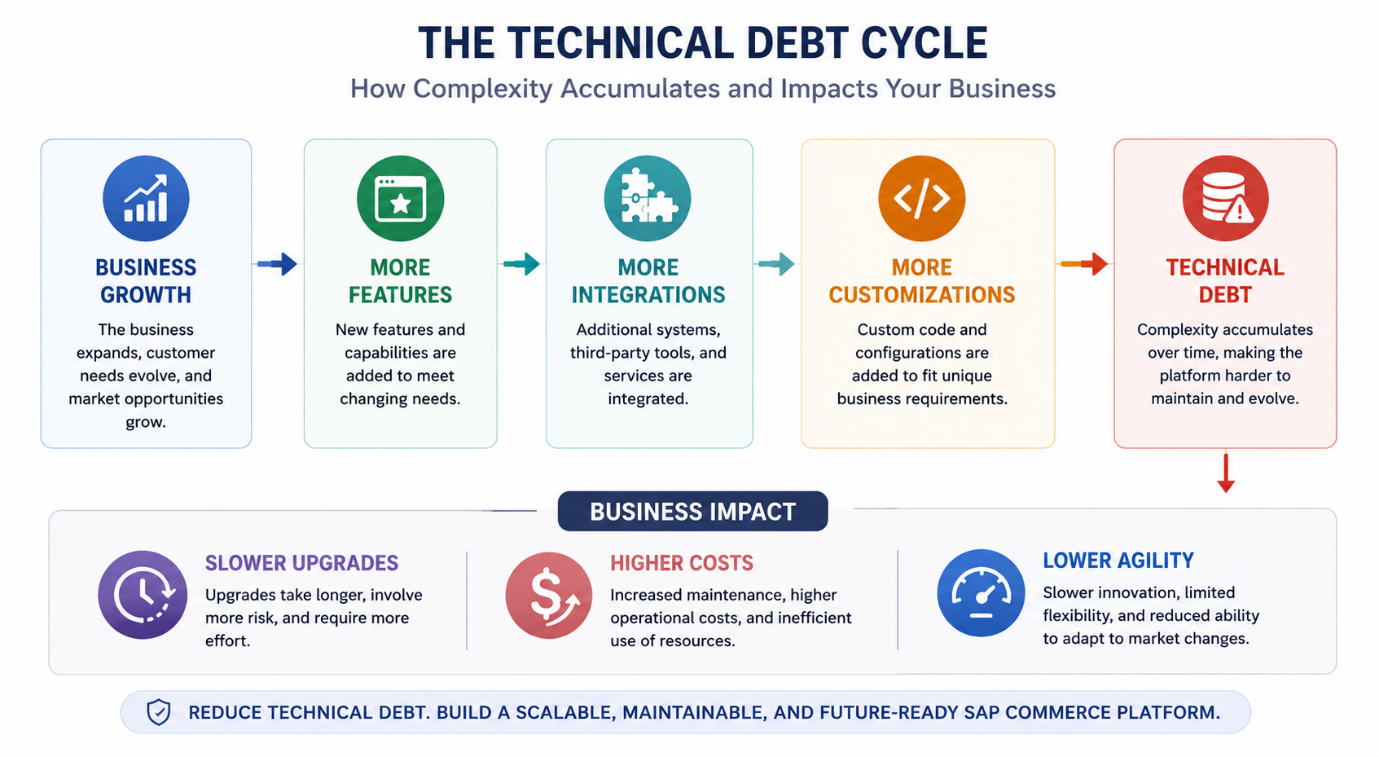
Technical Debt Examples
| Common Technical Debt | Business Impact |
|---|---|
| Excessive Custom Code | More difficult upgrades |
| Unsupported Extensions | Higher security and maintenance risk |
| Legacy Integrations | Increased operational complexity |
| Hardcoded Business Logic | Reduced flexibility |
| Obsolete APIs | Integration failures |
| Unused Modules | Higher infrastructure costs |
Assessment Areas
| Assessment Area | Evaluation Focus |
|---|---|
| Platform Architecture | Deployment model, cloud topology, high availability, failover |
| Custom Code | Deprecated customizations, duplicate logic, upgrade blockers |
| Extensions | Unsupported or unused extensions, third-party maintenance |
| Upgrade Readiness | Compatibility risks, dependencies, remediation planning |
Key Assessment Questions
- Does the current architecture support future business growth?
- Can SAP Commerce upgrades be completed with minimal disruption?
- Are unnecessary customizations increasing maintenance costs?
- Are unsupported extensions creating operational risk?
- Is the platform ready for future cloud modernization?
Deliverable
| Deliverable | Business Value |
|---|---|
| Technical Debt Report | Identify architectural risks and modernization priorities |
| Architecture Review | Evaluate scalability, resilience, and maintainability |
| Custom Code Assessment | Reduce upgrade complexity and technical debt |
| Upgrade Readiness Report | Assess compatibility risks and remediation efforts |
| Modernization Recommendations | Create a phased roadmap for platform optimization |
Assessment Dimension 6
Integrations & Data Flow
Building a Connected Enterprise Commerce Ecosystem
Modern SAP Commerce platforms are part of a broader enterprise ecosystem. They exchange data with ERP, CRM, marketing automation, payment gateways, logistics providers, Product Information Management (PIM), and customer data platforms. As the number of integrations grows, so does the complexity of maintaining reliable, secure, and real-time data flows.
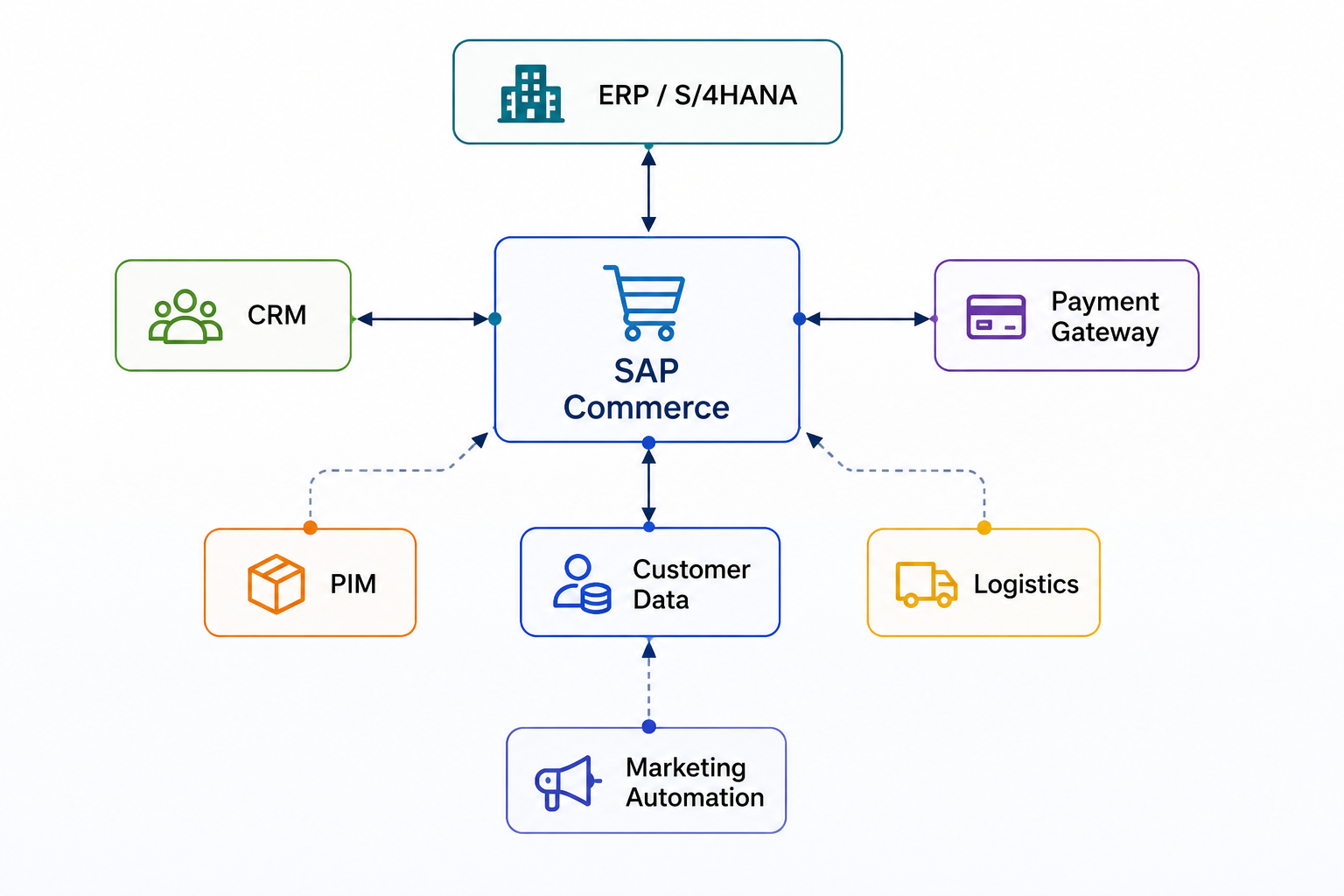
An Integration & Data Flow assessment evaluates whether business-critical systems remain synchronized, APIs perform reliably, and integration architecture supports scalability without introducing operational risk.
Assessment Areas
| Assessment Area | Evaluation Focus |
|---|---|
| API Performance | Response time, error rates, authentication, version management |
| Data Synchronization | Product, pricing, inventory, customer and order data consistency |
| Middleware | Message queues, transformation logic, monitoring, retry mechanisms |
| Third-Party Dependencies | Vendor risks, unsupported integrations, API limitations |
| Monitoring & Observability | API health, latency, failed transactions, alerts |
Key Assessment Questions
- Are APIs delivering reliable performance under peak loads?
- Is business data synchronized consistently across integrated systems?
- Are integration failures detected and resolved proactively?
- Are third-party dependencies introducing unnecessary operational risk?
- Does the integration architecture support future business growth?
Deliverables
| Deliverable | Business Value |
|---|---|
| Integration Inventory | Complete visibility into connected systems |
| API Health Report | Identify performance bottlenecks and failures |
| Data Flow Architecture | Document end-to-end system interactions |
| Dependency Analysis | Reduce integration complexity and risk |
| Integration Optimization Roadmap | Prioritize improvements for scalability and resilience |
Enterprise Insight
One of the greatest benefits of a comprehensive SAP Commerce Health Assessment is understanding how issues across different areas of the platform are connected. For example:
- Slow checkout performance may originate from inefficient APIs rather than the storefront.
- Upgrade delays often result from years of accumulated technical debt.
- Customer complaints may stem from inconsistent product or inventory data across integrated systems.
- Rising infrastructure costs can be caused by architectural inefficiencies instead of increased traffic.
By assessing business alignment, architecture, integrations, security, performance, and operations together, organizations gain a complete view of platform health and can prioritize improvements that deliver the greatest business value.
Assessment Dimension 7
Customer Experience & Journey
Delivering Seamless Commerce Experiences That Convert
A high-performing SAP Commerce platform is measured not only by technical stability but also by the quality of the customer experience. Slow pages, poor search, confusing navigation, and complex checkout processes increase friction, reduce conversions, and impact customer loyalty.
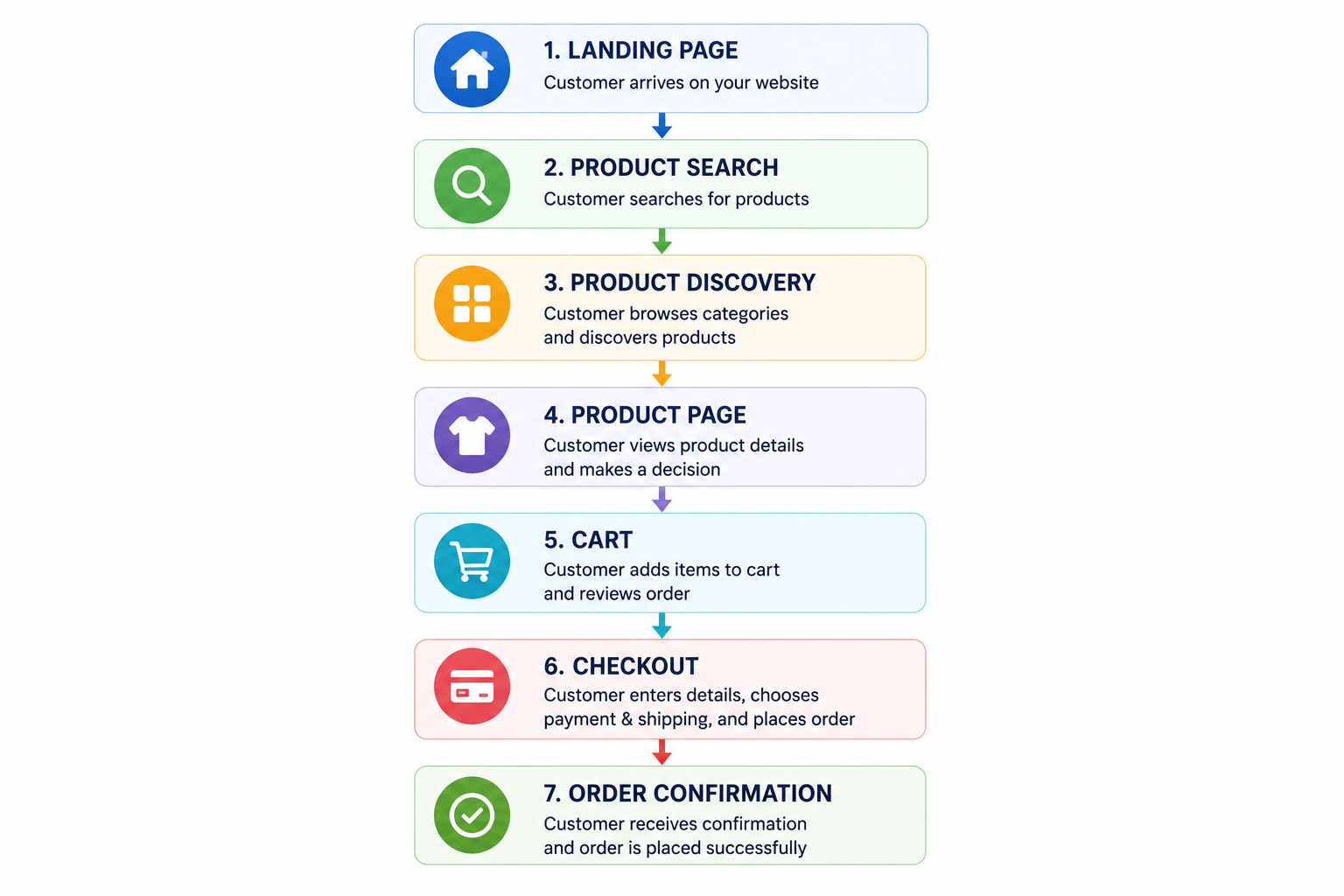
A Customer Experience assessment evaluates every stage of the buying journey to identify opportunities for improving usability, engagement, and conversion performance.
Assessment Areas
| Journey Stage | Evaluation Focus |
|---|---|
| Website Performance | Page speed, mobile responsiveness, image optimization |
| Search Experience | Search relevance, autocomplete, filters, zero-result searches |
| Product Discovery | Navigation, categories, recommendations, sorting |
| Checkout Experience | Checkout flow, payment performance, guest checkout |
| Personalization | Customer segmentation, dynamic content, recommendations |
Key Assessment Questions
- Are customers able to find products quickly?
- Does the website deliver a fast and responsive experience?
- Is the checkout process simple and friction-free?
- Are personalized experiences improving engagement?
- Where are customers abandoning their buying journey?
Deliverables
| Deliverable | Business Value |
|---|---|
| Customer Journey Review | Identify friction across the buying journey |
| UX Assessment Report | Improve usability and navigation |
| Conversion Optimization Plan | Increase conversions and reduce abandonment |
| Performance Recommendations | Improve customer experience across devices |
| Personalization Assessment | Enhance engagement through tailored experiences |
Assessment Dimension 8
Operational Excellence & Governance
Ensuring Long-Term Platform Stability and Continuous Improvement
Implementing SAP Commerce is only the beginning. Long-term success depends on strong governance, operational discipline, and continuous optimization. As business requirements evolve, organizations need structured processes to manage changes, monitor platform health, resolve incidents quickly, and continuously improve performance.
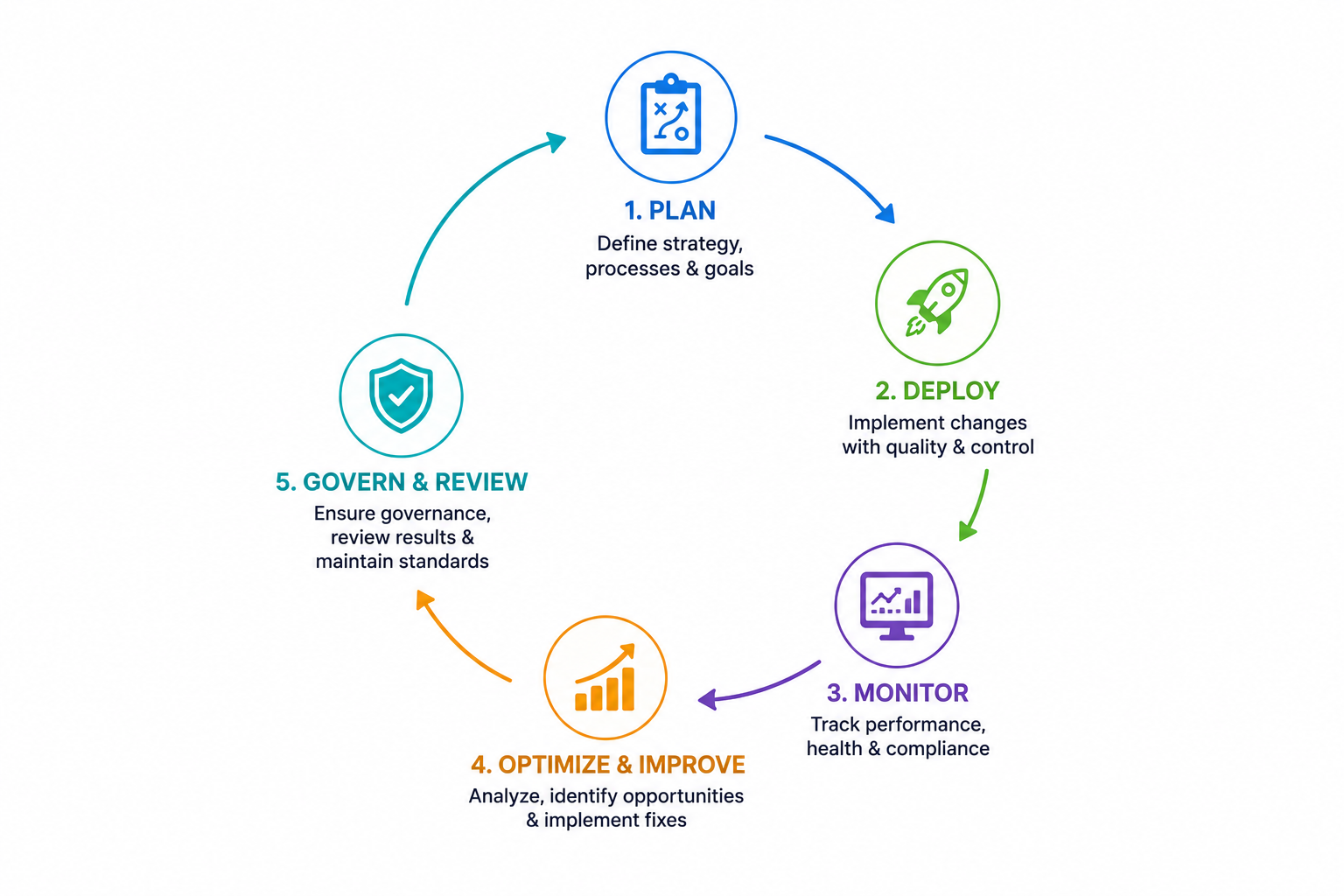
An Operational Excellence assessment evaluates whether the people, processes, and governance supporting SAP Commerce are mature enough to sustain long-term business growth.
Assessment Areas
| Journey Stage | Evaluation Focus |
|---|---|
| Change Management | Release management, deployment processes, approval workflows |
| Monitoring & Observability | Platform availability, API health, infrastructure utilization, security alerts |
| Incident Management | Response procedures, escalation, recovery objectives, root cause analysis |
| Operational Documentation | Architecture, integrations, deployment standards, recovery procedures |
| Continuous Improvement | Performance reviews, technical debt, customer feedback, KPI monitoring |
Key Assessment Questions
- Are platform changes governed through a structured release process?
- Is the platform continuously monitored for performance and availability?
- Are incidents resolved quickly with documented recovery procedures?
- Is operational documentation accurate and up to date?
- Are business and technical KPIs reviewed regularly to drive continuous improvement?
Deliverables
| Deliverable | Business Value |
|---|---|
| Operational Maturity Report | Measure governance and operational readiness |
| Governance Framework | Standardize operational processes and controls |
| Monitoring Recommendations | Improve visibility into platform health |
| KPI Dashboard | Track operational and business performance |
| Continuous Improvement Roadmap | Prioritize ongoing optimization initiatives |
SAP Commerce Health Scorecard
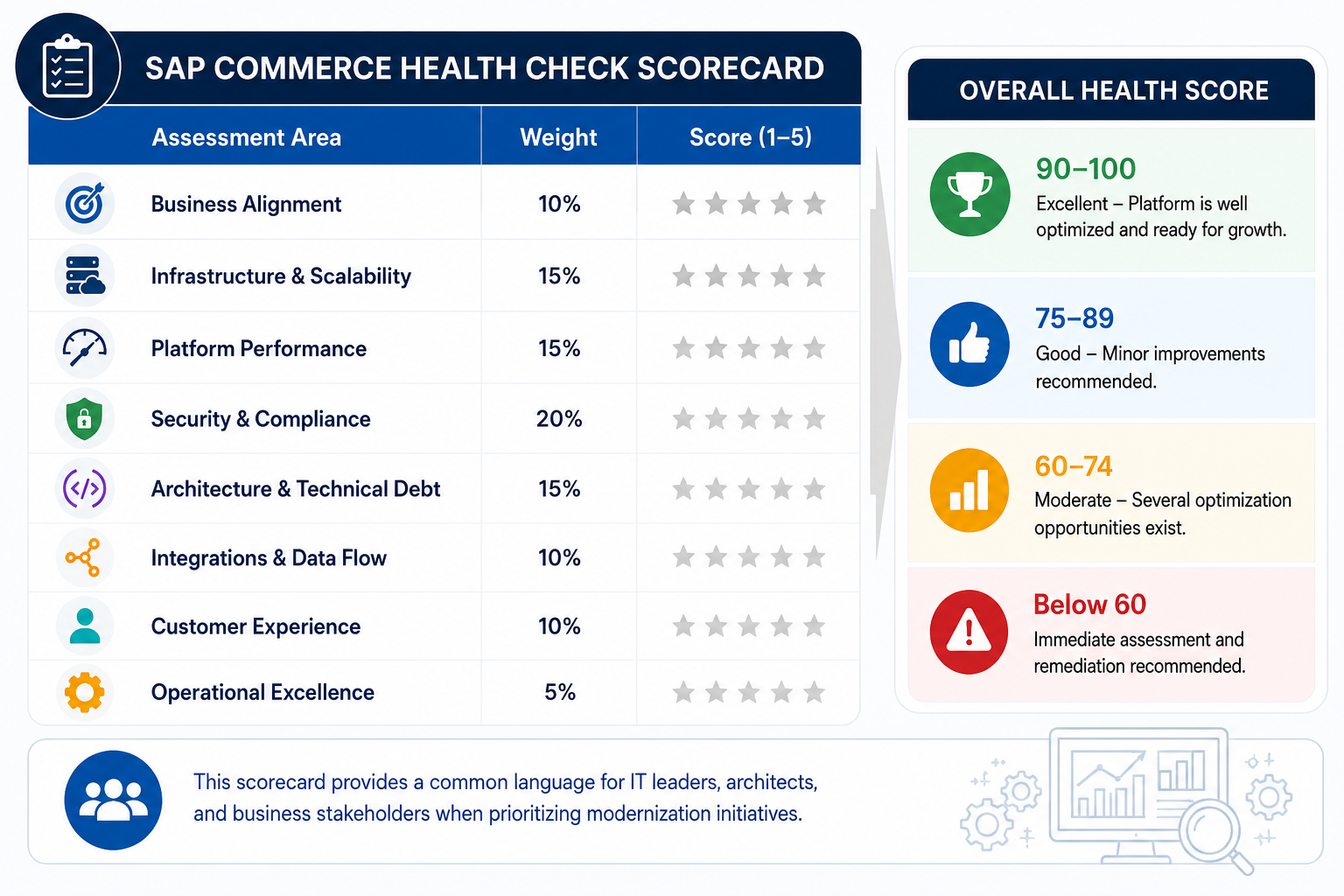
Rather than treating every issue equally, Qnovate recommends evaluating SAP Commerce environments using a weighted scorecard that helps prioritize improvement efforts.
SAP Commerce Health Verification Checklist
Before considering your platform "healthy," verify the following:
Business & Strategy
- Business objectives are clearly defined
- Platform supports future growth plans.
- Executive sponsorship is established.
Infrastructure
- Auto-scaling is configured.
- Disaster recovery is tested.
- Backup strategy is documented.
Performance
- Core Web Vitals meet targets.
- Product pages load quickly.
- Search performance is optimized.
- Checkout latency is monitored.
Security
- Role-based access is enforced.
- Security patches are current.
- Vulnerability scans are completed.
- Compliance requirements are validated.
Architecture
- Technical debt has been assessed.
- Custom code is documented.
- Upgrade blockers are identified.
Integrations
- APIs are monitored.
- Data synchronization is validated.
- Third-party integrations are documented.
Customer Experience
- Mobile experience is optimized.
- Search accuracy is reviewed.
- Checkout experience is friction-free.
Operations
- Monitoring dashboards are available.
- Incident response procedures are documented.
Key Enterprise Commerce KPIs
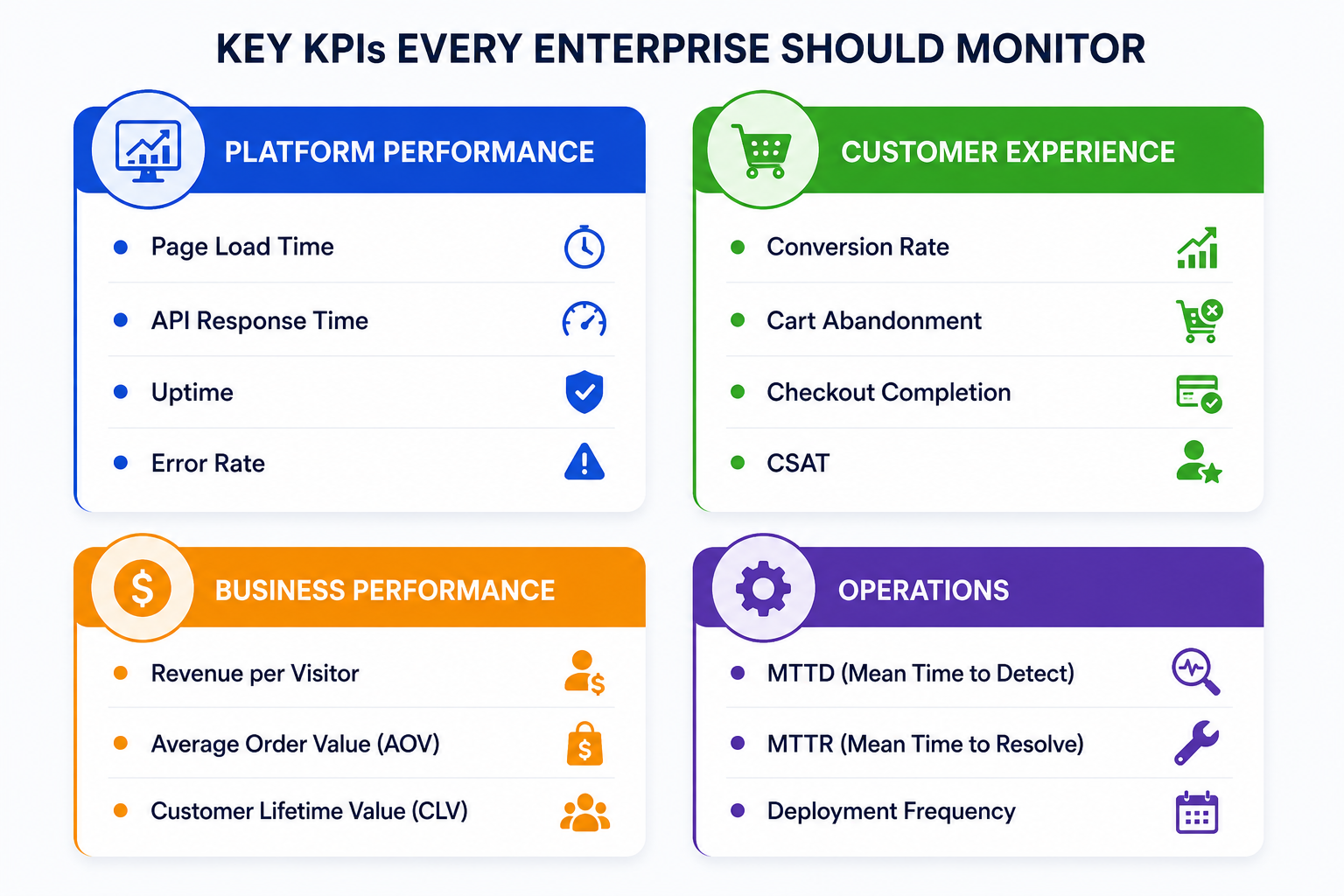
A successful SAP Commerce platform should be measured using both technical and business KPIs. Tracking these metrics helps organizations identify performance bottlenecks, improve customer experience, and measure business impact.
Still have questions?
Regular assessments help identify performance bottlenecks, security vulnerabilities, technical debt, and operational inefficiencies before they affect customers or business operations.
Most organizations benefit from conducting a comprehensive health check at least once a year. Additional assessments are recommended before major platform upgrades, seasonal traffic peaks, significant architectural changes, or large-scale business initiatives.
Yes. Common indicators include: • Slow website performance • Increasing cart abandonment • Frequent production issues • Upgrade challenges • Rising infrastructure costs • Security concerns • Customer complaints • Integration failures
A comprehensive assessment evaluates: • Business alignment • Infrastructure • Performance • Security • Architecture • Technical debt • Integrations • Customer experience • Governance • Operational maturity
The duration depends on the complexity of the SAP Commerce environment. Smaller implementations may take one to two weeks, while large enterprise environments with multiple integrations and customizations may require several weeks.
Ready To Transform your Business?
Ready to transform your business and need more information about our conversion accelerator?
Contact with Our Advisor